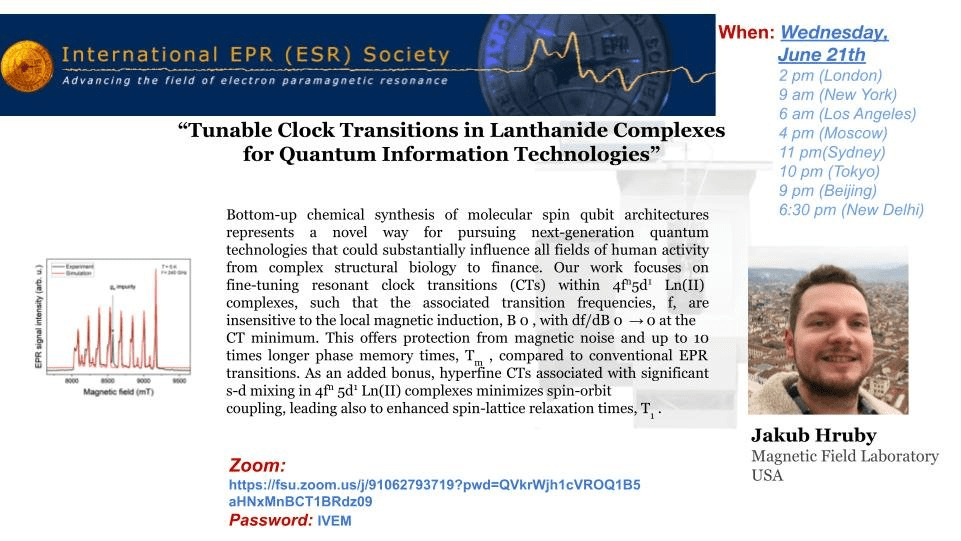
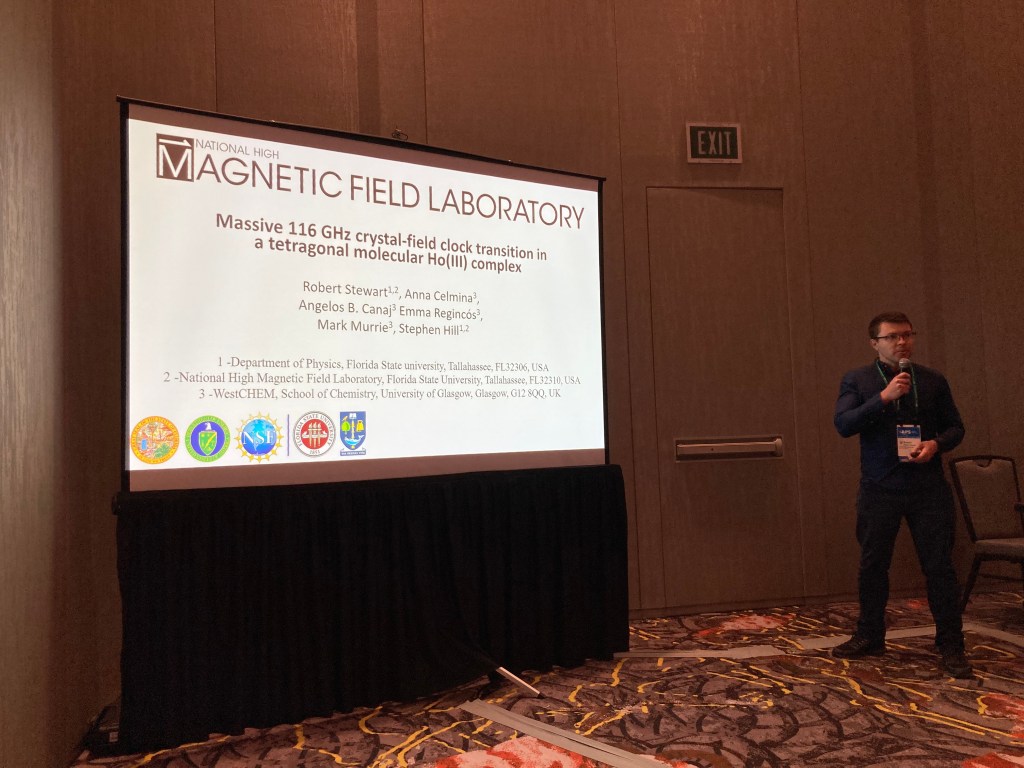
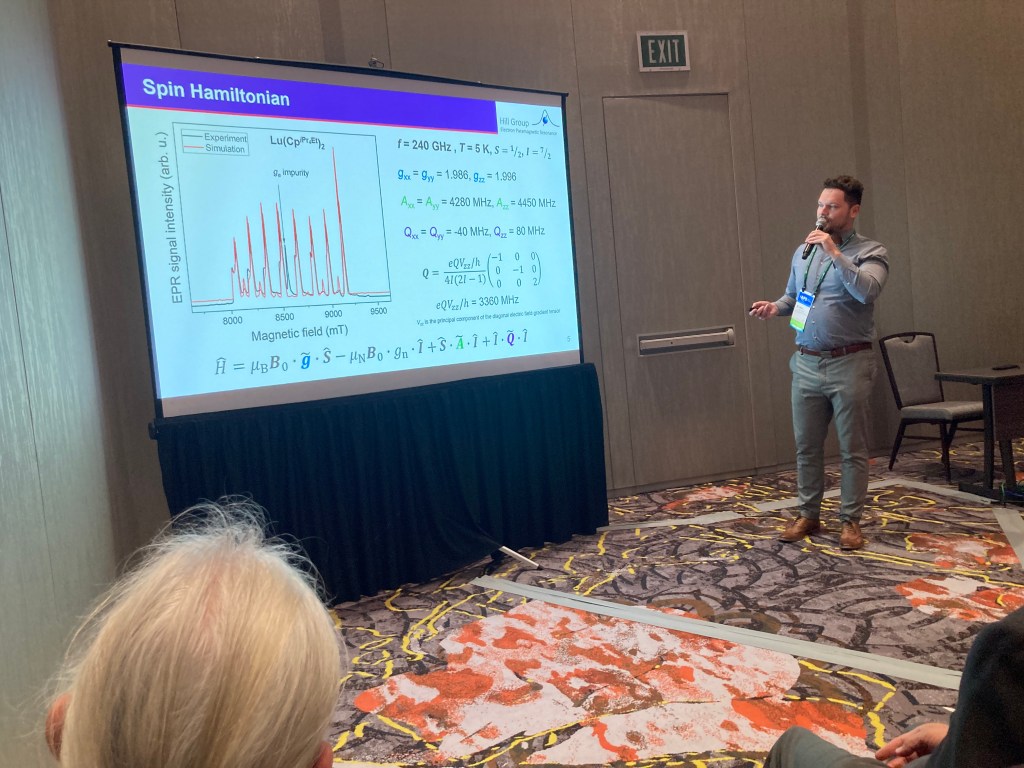
Our postdoc Jakub Hrubý will give online talk about “Tunable Clock Transitions in Lanthanide Complexes for Quantum Information Technologies ” at IVEM – EPR seminar on Wednesday, June 21, 9:00 AM EST. Feel free to join the discussion at Zoom: https://fsu.zoom.us/j/91062793719?pwd=QVkrWjh1cVROQ1B5aHNxMnBCT1BRdz09.
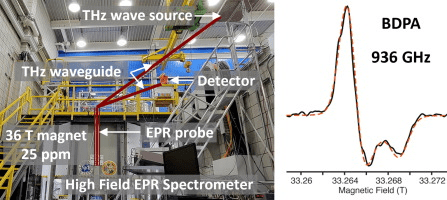
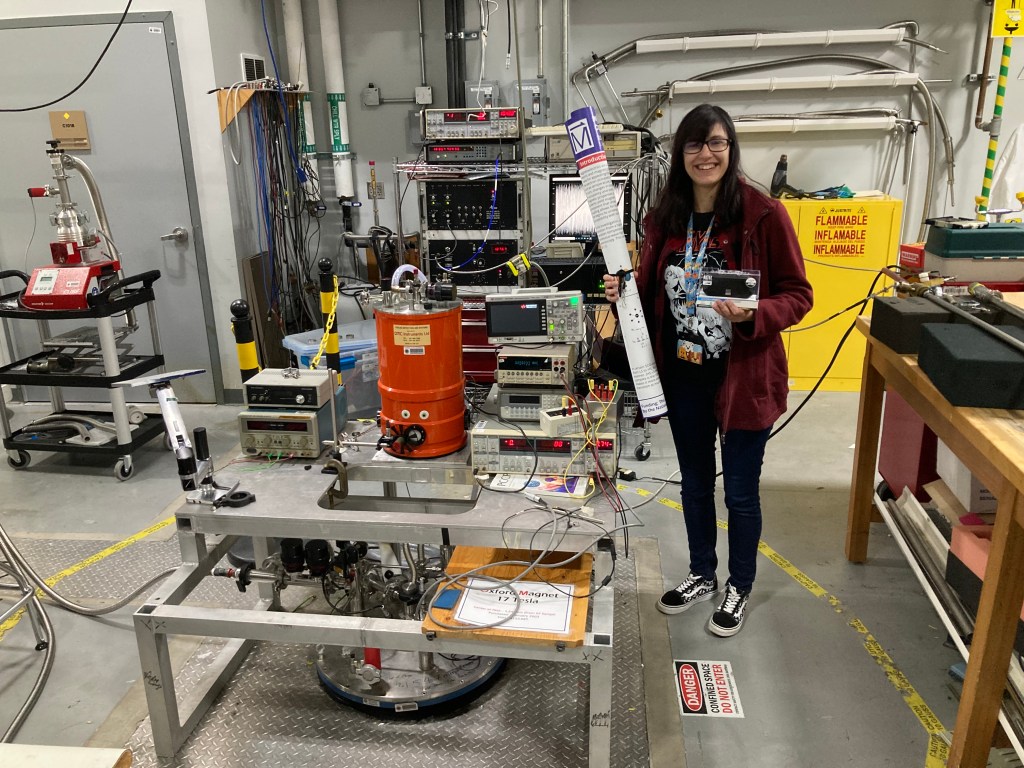
Electron Paramagnetic Resonance (EPR) is a powerful technique to study materials and biological samples on an atomic scale. High-field EPR in particular enables extracting very small g-anisotropies in organic radicals and half-filled 3d and 4f metal ions such as MnII (3d5) or GdIII (4f7), and resolving EPR signals from unpaired spins with very close g-values, both of which provide high-resolution details of the local atomic environment. Before the recent commissioning of the high-homogeneity Series Connected Hybrid magnet (SCH, superconducting + resistive) at the National High Magnetic Field Laboratory (NHMFL), the highest-field, high-resolution EPR spectrometer available was limited to 25 T using a purely resistive “Keck” magnet at the NHMFL. Herein, we report the first EPR experiments performed using the SCH magnet capable of reaching the field of 36 T, corresponding to an EPR frequency of 1 THz for g = 2. The magnet’s intrinsic homogeneity (25 ppm, that is 0.9 mT at 36 T over 1 cm diameter, 1 cm length cylinder) was previously established by NMR. We characterized the magnet’s temporal stability (5 ppm, which is 0.2 mT at 36 T over one-minute, the typical acquisition time) using 2,2-diphenyl-1-picrylhydrazyl (DPPH). This high resolution enables resolving the weak g-anisotropy of 1,3-bis(diphenylene)-2-phenylallyl (BDPA), Δg = 2.5 × 10⁻⁴ obtained from measurements at 932 GHz and 33 T. Subsequently, we recorded EPR spectra at multiple frequencies for two GdIII complexes with potential applications as spin labels. We demonstrated a significant reduction in line broadening in Gd[DTPA], attributed to second order zero field splitting, and a resolution enhancement of g-tensor anisotropy for Gd[sTPATCN]-SL.
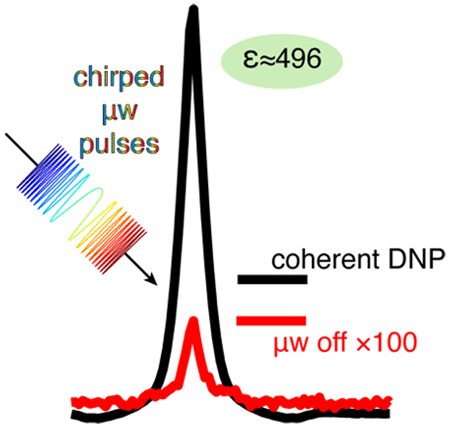
This paper presents a study of coherent dynamic nuclear polarization (DNP) using frequency swept pulses at 94 GHz which optimize the polarization transfer efficiency. Accordingly, an enhancement ε ∼ 496 was observed using 10 mM trityl-OX063 as the polarizing agent in a standard 6:3:1 d8-glycerol/D2O/H2O glassing matrix at 70 K. At present, this is the largest DNP enhancement reported at this microwave frequency and temperature. Furthermore, the frequency swept pulses enhance the nuclear magnetic resonance (NMR) signal and reduce the recycle delay, accelerating the NMR signal acquisition.
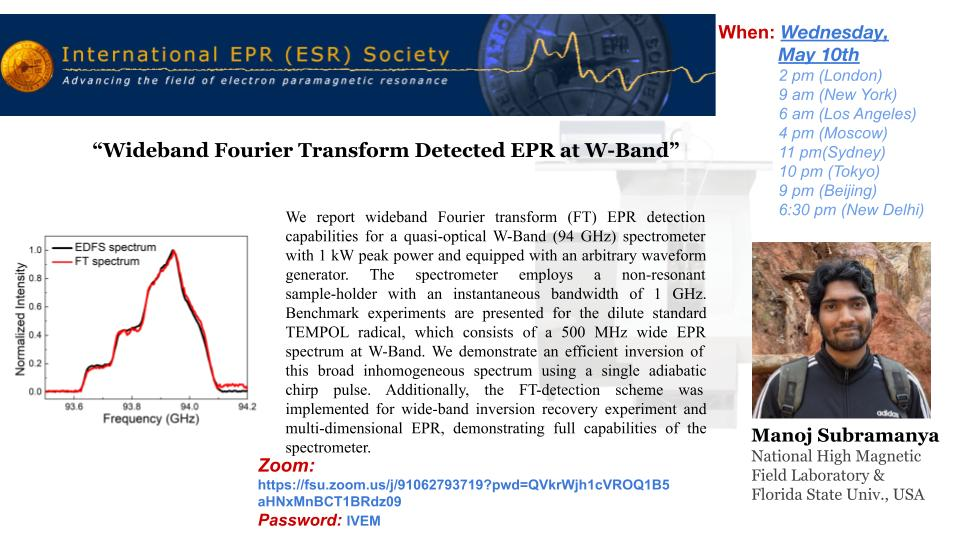
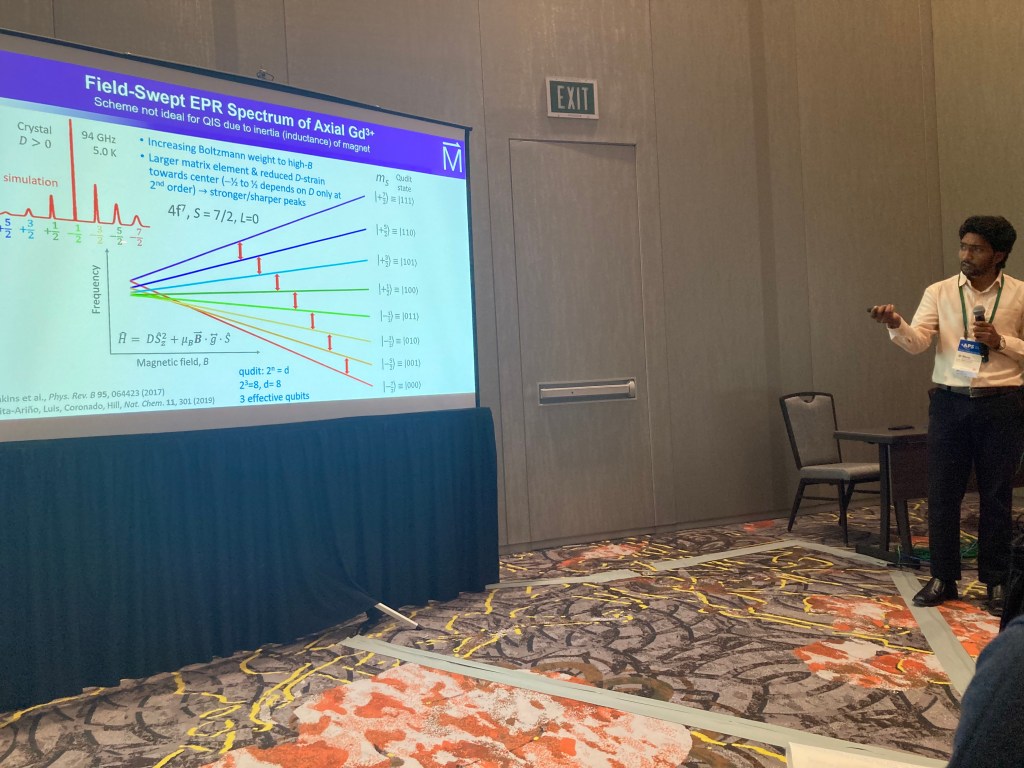
Our graduate student Manoj Subramanya will give online talk about “Wideband Fourier Transform Detected EPR at W-Band” at IVEM – EPR seminar on Wednesday, May 10, 9:00 AM EST. Feel free to join the discussion at Zoom: https://fsu.zoom.us/j/91062793719?pwd=QVkrWjh1cVROQ1B5aHNxMnBCT1BRdz09.
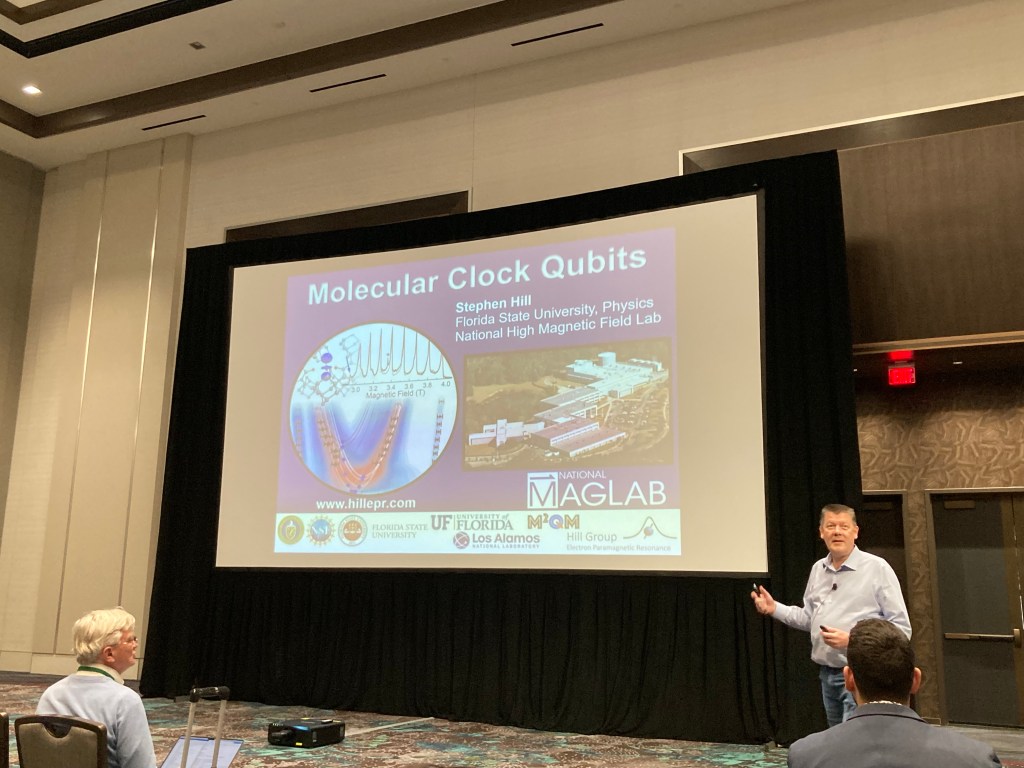
Steve gives keynote talk about Molecular Spins for Next Generation Quantum Technologies at National Quantum Technology Forum (NQTF) at Clemson University, South Carolina, April 14-15, 2023.
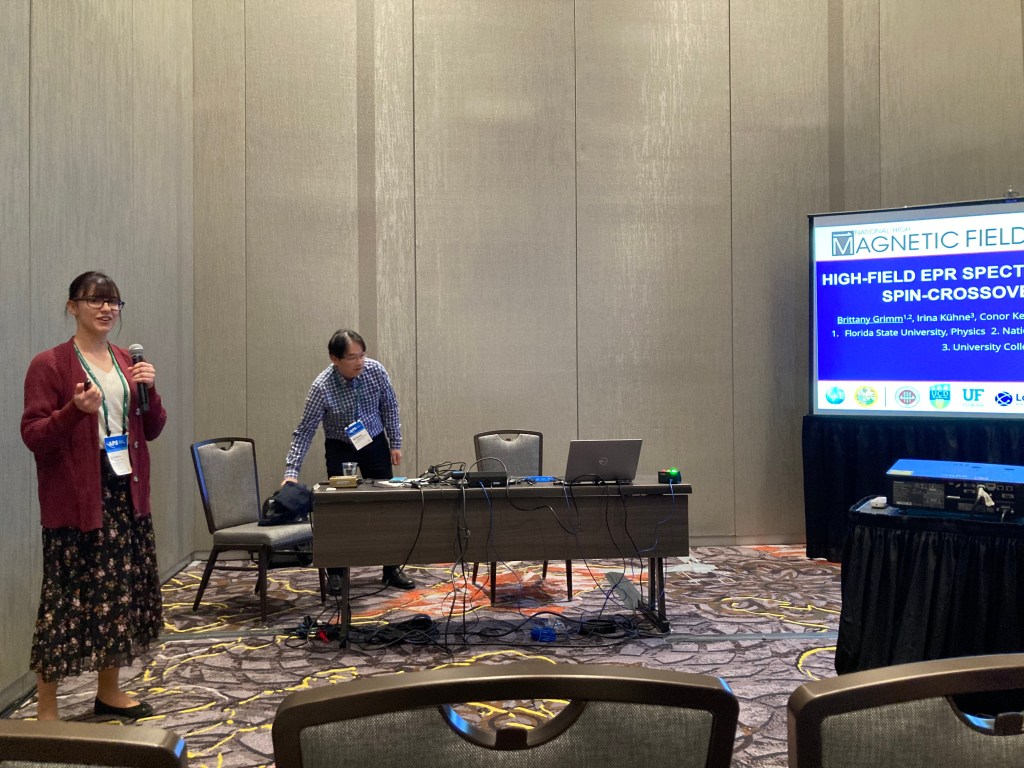
The poster addresses spin crossovers. Magnetoelectrics are a class of multiferroic material whereby coupling between the electric and magnetic properties are present. Spin crossover (SCO) metalorganics make for appealing magnetoelectric candidates due to the relative ease at which the arrangement of electrons within the atomic d-orbitals can be changed with external stimuli, such as temperature, pressure, electric field, magnetic field, and optical irradiation. Wherein, changes in metal-ligand bond lengths are strongly correlated with overall change in electronic spin. Coupling between the molecular magnetic properties and the elastic degrees of freedom of the lattice, as well as the charge in these systems yield magnetic/charge bi-stability, and more importantly, a strong spin-lattice component that drives cooperativity via local lattice strains. Thus, spin-lattice coupling allows for rapid propagation of spin switching to adjacent sites when one site begins to undergo a phase change, which allow for large changes in magnetic susceptibility with relatively small perturbations.
In this investigation, a metalorganic Mn3+ SCO complex that undergoes a complete transition from a high spin (HS) S = 2 state to a low spin (LS) S = 1 state below a sharp transition (T1/2 = 51 K; with < 10 K hysteresis), was studied using continuous-wave high-field powder electron paramagnetic resonance (EPR) spectroscopy. Magnetic anisotropy in d-block transition metals is dominated by spin-orbit coupling, which admixes crystal field states, and can be characterized by parameterizing both g and the zero field splitting terms D and E in the effective spin Hamiltonian. In some SCO complexes, it can be too energetically costly to convert all the sites in the lattice. This results in an inhomogeneous mixture of phases below the transition temperature, complicating the characterization of the EPR spectrum. Therefore, with the advantage of studying a complex exhibiting a complete SCO transition around temperatures amenable to study using EPR, the ZFS parameters were obtained for both the LS and HS states.
Brittany Grimm in lab with winning poster and prize
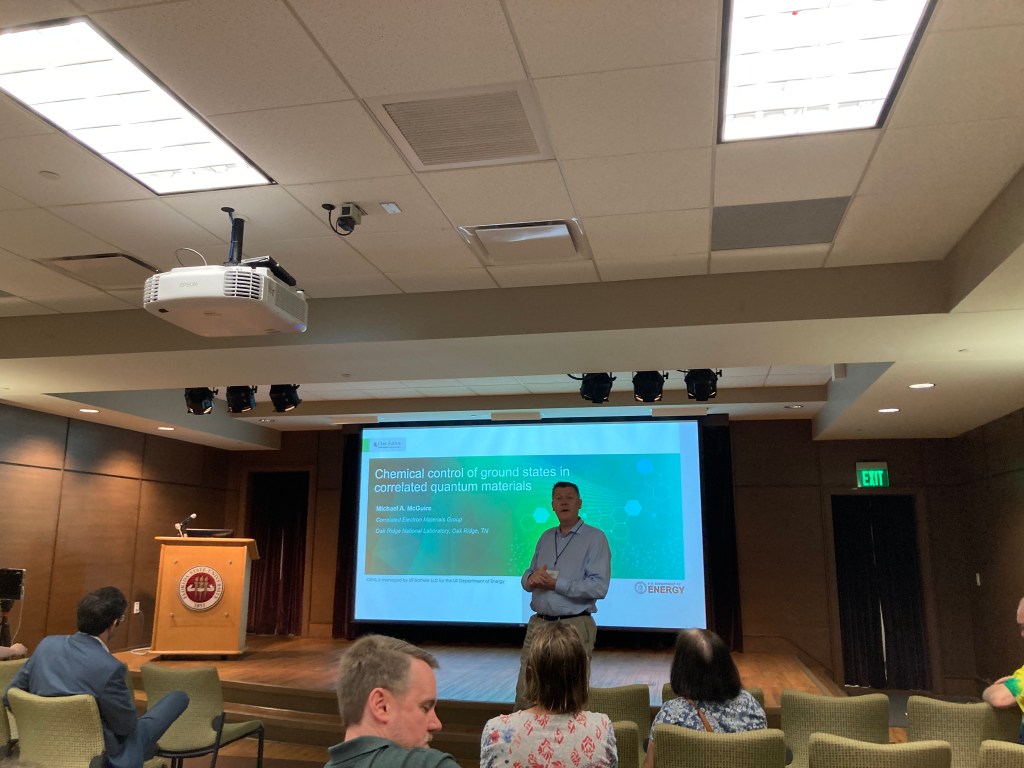
The Florida State University is pleased to announce a three-day symposium on Quantum Science and Engineering (QSE), with the goal to highlight cutting-edge research activities in this forefront area of critical national importance. The symposium is intended to provide opportunities to learn about various aspects of QSE, explore potential collaborations, and educate junior scientists and novices to this broad interdisciplinary field. We therefore encourage anyone with interest in QSE to consider participating. The symposium will provide opportunities for faculty, postdocs, and students to present their work in the form of short talks and posters.
Steve Hill chairing the opening sessionSpeech by FSU president Richard McCullough
The ability to design quantum systems that decouple from environmental noise sources is highly desirable for development of quantum technologies with optimal coherence. The chemical tunability of electronic states in magnetic molecules combined with advanced electron spin resonance techniques provides excellent opportunities to address this problem. Indeed, so-called clock transitions have been shown to protect molecular spin qubits from magnetic noise, giving rise to significantly enhanced coherence. Here we conduct a spectroscopic and computational investigation of this physics, focusing on the role of the nuclear bath. Away from the clock transition, linear coupling to the nuclear degrees of freedom causes a modulation and decay of electronic coherence, as quantified via electron spin echo signals generated experimentally and in silico. Meanwhile, the effective hyperfine interaction vanishes at the clock transition, resulting in electron-nuclear decoupling and an absence of quantum information leakage to the nuclear bath, providing opportunities to characterize other decoherence sources.