
Steve along with two professors (Lisa Hightow-Weidman and Laura Reina) were named fellows of the Academy of Science, Engineering and Medicine of Florida (ASEMFL). Congratulations!

Steve along with two professors (Lisa Hightow-Weidman and Laura Reina) were named fellows of the Academy of Science, Engineering and Medicine of Florida (ASEMFL). Congratulations!
Annika Lagy uses electron paramagnetic resonance (EPR) spectroscopy to characterize the differences between a group of five Ni samples with different ligands. Each Ni sample is ground into a fine powder and placed in the center of a magnet where it is irradiated with microwaves. Due to the Zeeman effect, when a magnetic field is applied, the spin states of unpaired electrons in the Ni become non-degenerate and the difference in energy between them increases linearly with the magnetic field. There is a particular magnetic field value where this energy difference is in resonance, or proportional to the microwave frequency, allowing the electrons to be excited to a different spin state. In EPR, the magnetic field is swept at a constant microwave frequency and an absorption spectrum is recorded to detect when these excitations occur. Due to the large zero-field splitting in the Ni samples and the restriction of using frequencies below 600 GHz in EPR, we are primarily observing the parallel mode transitions between the +1 and -1 spin states.

Andrew Cook studies single-crystal samples that are mounted onto a probe capable of in situ two-axis sample rotation. The probe is then loaded into the center of a horizontal-field, split-pair magnet encased in a cryogenic chamber. The special electron configuration of interesting samples allow for unpaired electrons to be studied using this experimental setup. There are multiple EPR detection schemes, the method we use is just one of these. With our method, Microwave frequencies are generated, sent to the sample, retrieved, analyzed, and compared, using a custom network of electronics. Excitations in the unpaired electrons can be inferred through these signals. The excitation from one energy level to another in the presence of a magnetic field, known as resonance, is of focus to my cohort. On top of differences due to electronic structure, differing the values for the orientation of the sample, microwave frequency, chamber temperature and magnetic field strength all have an effect on how a resonance occurs. EPR has various applications in Quantum Information/Computing, Chemistry, and Biology.

Since 1986 Bruker BioSpin has generously sponsored an annual lectureship and prize, given to a scientist who has made a major contribution to the application of ESR spectroscopy in chemical or biological systems. The RSC ESR Spectroscopy Group and Bruker are excited to announce the Bruker lecturer 2025 Professor Stephen Hill for,
“his seminal contributions to EPR in terms of both world-leading and unique instrument design as well imaginative and expert application of high field EPR to the study of low dimensional systems. His work has opened up new avenues for EPR driven developments including in, but not limited to, the fields of quantum information science and the study of polymetallic transition metal complexes. Crucially, as Director of the Electron Magnetic Resonance user program at the NHMFL he has supported and fostered the international and national EPR communities with unique scientific expertise and admirable dedication.”
The 2025 Bruker lecture is the 40th Anniversary of this prestigious prize, and we are excited to celebrate this milestone and Stephen’s achievement at our London conference in spring 2025. The list of winners of the previous 39 prizes Bruker Prize is available here. We are grateful to Bruker for their longstanding support of this prize.
Source: https://www.esr-group.org/conferences/2025-conference-london/bruker-prizes-2025/

Sabastian Atwood joins the group as a postdoctoral fellow through Florida State University’s Quantum Initiative. Sabastian received a PhD in physics from the University of Utah with a focus on experimental condensed matter physics. His graduate research was on strong-drive magnetic resonance phenomena among weakly coupled electron-hole charge-carrier pairs in organic light-emitting diodes. Sabastian previously received his Bachelor’s degree in physics from the University of Utah, and as an undergraduate, he participated in research with the university’s high-energy cosmic ray group. Prior to his education in physics, Sabastian received a Bachelor’s degree in classics and German studies from Cornell University and worked in project management in the medical communications industry.
Welcome aboard!

Our graduate student Robert Stewart passed his defense on June 20th, 2024. All the best in the next challenges and career steps. Congratulations!
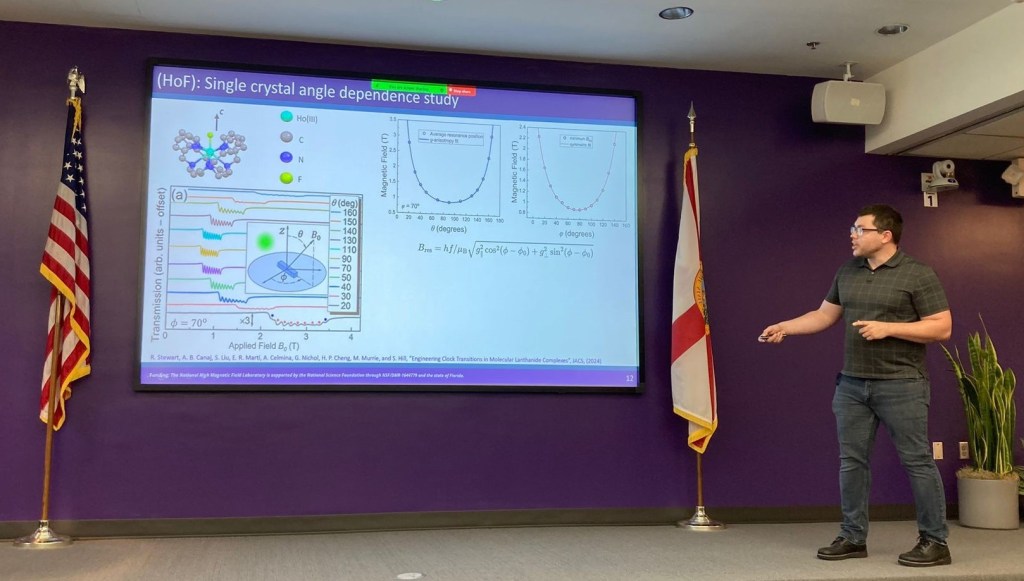
Find out more about Robert´s PhD results in recently published paper: Stewart, R., Canaj, A. B., Liu, S., Martí, E. R., Celmina, A., Nichol, G., Cheng, H.-P., Murrie, M. & Hill, S. (2024). Engineering Clock Transitions in Molecular Lanthanide Complexes. J. Am. Chem. Soc., 146, 16, 11083-11094. READ MORE
Ronghe Wang is a new member of the group. She completed her bachelor’s degree in Physics and Math in University of California, Berkeley. She worked as a research assistant on Prospects for Measuring the Cross Section for the Associated Production of a Higgs Boson and a Charm Quark. This project provided a motivation for starting to develop this analysis prior to the High Luminosity-Large Hadron Collider data-taking and substantially enhanced in various beyond the Standard Model (BSM) scenarios. She performed a cut-based event selection to identify the signal-to-background separation and computed the significance of the Higgs decay. She also designed and deployed a Machine Learning model (feedforward neural network) and Monte Carlo simulations in a particle decay process, which increased the accuracy of the significance in High luminosity scenario and the Run 2+Run 3 scenario.
She is now pursuing PhD degree at Florida State University and joining the Hill Group to do research projects on the HiPER Spectrometer. Welcome aboard!

Spin in semiconductors facilitates magnetically controlled optoelectronic and spintronic devices. In metal halide perovskites (MHPs), doping magnetic ions is proven to be a simple and efficient approach to introducing a spin magnetic momentum. In this work, we present a facile metal ion doping protocol through the vapor-phase metal halide insertion reaction to the chemical vapor deposition (CVD)-grown ultrathin Cs3BiBr6 perovskites. The Fe-doped bismuth halide (Fe:CBBr) perovskites demonstrate that the iron spins are successfully incorporated into the lattice, as revealed by the spin-phonon coupling below the critical temperature Tc around 50 K observed through temperature-dependent Raman spectroscopy. Furthermore, the phonons exhibit significant softening under an applied magnetic field, possibly originating from magnetostriction and spin exchange interaction. The spin-phonon coupling in Fe:CBBr potentially provides an efficient way to tune the spin and lattice parameters for halide perovskite-based spintronics.

Quang Nhat Nguyen is a new member of the group. He completed his bachelor’s degree in Physics (Teacher Education) at Ho Chi Minh City University of Education (HCMUE), Vietnam. At the undergraduate level, he worked at the Computational Physics Key Laboratory at HCMUE. His main interest was focused on Computational Physics where he participated in developing a so-called modulated perturbation method to study the property of magnetoexciton in two-dimensional material such as TMDCs (Transition Metal Dichalcogenides). This method allows to calculate the exact energy spectra of exciton in TMDCs under the application of arbitrary magnetic field strength, which can be used to extract relevant information (effective masses of electron and hole, diamagnetic constant, g-factor,…) from its experimental spectra.

He is now pursuing his PhD degree at Florida State University and joining the Hill Group to do research projects on the W-Band HiPER Spectrometer. Welcome aboard!
The contribution of heavy-atom substituents to the overall spin-orbit interaction in two classes of organic radical molecular magnets is discussed. In “single-orbital” radicals, spin-orbit coupling (SOC) effects are well described with reference to pairwise anisotropic exchange interactions between singly occupied spin-bearing orbitals on neighboring molecules; anisotropy requires the presence of spin density on heavy-atom sites with principal quantum number n>3. In “multiorbital” radicals, SOC involving virtual orbitals also contributes to anisotropic exchange and, as a result, the presence of heavy (n>3) atoms in formally non-spin-bearing sites can enhance pseudodipolar ferromagnetic interaction terms. To demonstrate these effects, ferromagnetic and antiferromagnetic resonance spectroscopies have been used to probe the exchange anisotropy in two organic magnets, one a “single-orbital” ferromagnet, the other a “multiorbital” spin-canted antiferromagnet, both of which contain a heavy-atom iodine (n=5) substituent. While the symmetry of the singly occupied molecular orbital in both radicals precludes spin-orbit contributions from iodine to the overall exchange anisotropy, the symmetry and energetically low-lying nature of the lowest unoccupied molecular orbital in the latter allows for appreciable spin density at the site of iodine substitution and, hence, a large exchange anisotropy.
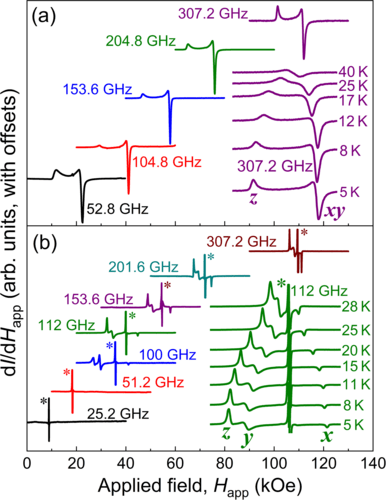
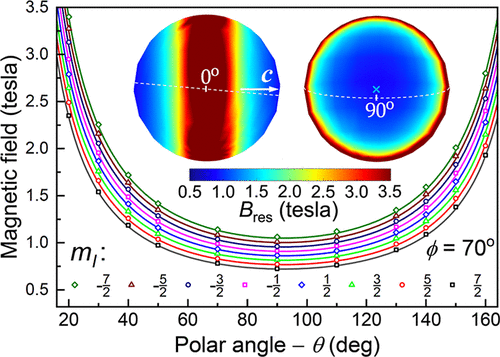
Molecular lanthanide (Ln) complexes are promising candidates for the development of next-generation quantum technologies. High-symmetry structures incorporating integer spin Ln ions can give rise to well-isolated crystal field quasi-doublet ground states, i.e., quantum two-level systems that may serve as the basis for magnetic qubits. Recent work has shown that symmetry lowering of the coordination environment around the Ln ion can produce an avoided crossing or clock transition within the ground doublet, leading to significantly enhanced coherence. Here, we employ single-crystal high-frequency electron paramagnetic resonance spectroscopy and high-level ab initio calculations to carry out a detailed investigation of the nine-coordinate complexes, [HoIIIL1L2], where L1 = 1,4,7,10-tetrakis(2-pyridylmethyl)-1,4,7,10-tetraaza-cyclododecane and L2 = F– (1) or [MeCN]0 (2). The pseudo-4-fold symmetry imposed by the neutral organic ligand scaffold (L1) and the apical anionic fluoride ion generates a strong axial anisotropy with an mJ = ±8 ground-state quasi-doublet in 1, where mJ denotes the projection of the J = 8 spin–orbital moment onto the ∼C4 axis. Meanwhile, off-diagonal crystal field interactions give rise to a giant 116.4 ± 1.0 GHz clock transition within this doublet. We then demonstrate targeted crystal field engineering of the clock transition by replacing F– with neutral MeCN (2), resulting in an increase in the clock transition frequency by a factor of 2.2. The experimental results are in broad agreement with quantum chemical calculations. This tunability is highly desirable because decoherence caused by second-order sensitivity to magnetic noise scales inversely with the clock transition frequency.
 HILL GROUP EPR