APS TV Video Highlight – Quantum Initiative at Florida State University

American Physical Society (APS) TV features our lab in video highlight about FSU Quantum Initiative at Florida State University.

APS TV Video Highlight, March 2024.

The FSU Quantum Initiative at Florida State University is at the forefront of quantum science and engineering, with a focus on groundbreaking research and innovation. The initiative has made bold investments, dedicating over $20 million to quantum science and engineering over the next three years. This funding supports the hiring of new faculty members, acquisition of equipment, and the establishment of dedicated space in the Interdisciplinary Research and Commercialization Building. Additionally, seed money has been allocated for a new program focused on this emerging field.

FSU Quantum is actively involved in exploring quantum information science and developing new technologies as part of the National Quantum Initiative, a $2.6 billion federal effort. Researchers at FSU are engaged in various projects, such as developing quantum bit platforms and participating in research initiatives sponsored by agencies like the Department of Energy. Quantum engineering at FSU leverages the principles of quantum mechanics to push technological boundaries. Quantum computers, for instance, harness the unique properties of quantum bits to solve complex problems efficiently. FSU’s investments aim to position the university as a major player in quantum science and engineering, bridging the gap in the Southeast and solidifying its leadership in this transformative field.

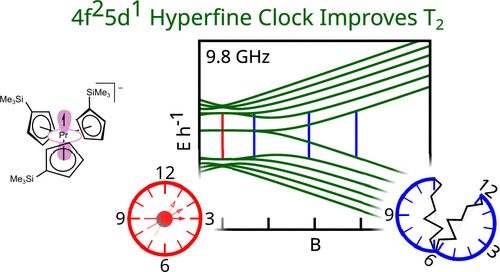
NEW PUBLICATION – Identification of an X-Band Clock Transition in Cp′3Pr– Enabled by a 4f2 5d1 Configuration

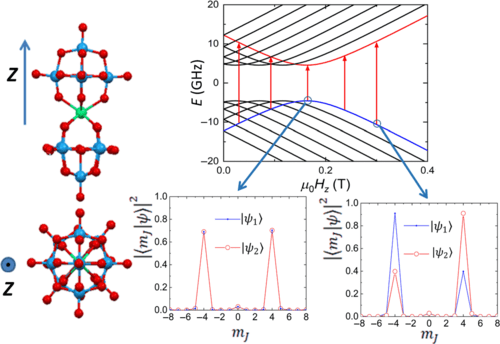
Molecular qubits offer an attractive basis for quantum information processing, but challenges remain with regard to sustained coherence. Qubits based on clock transitions offer a method to improve the coherence times. We propose a general strategy for identifying molecules with high-frequency clock transitions in systems where a d electron is coupled to a crystal-field singlet state of an f configuration, resulting in an MJ = ±1/2 ground state with strong hyperfine coupling. Using this approach, a 9.834 GHz clock transition was identified in a molecular Pr complex, [K(crypt)][Cp′3PrII], leading to 3-fold enhancements in T2 relative to other transitions in the spectrum. This result indicates the promise of the design principles outlined here for the further development of f-element systems for quantum information applications.

NEW TEAM MEMBER – Dr. Kavipriya Thangavel

Dr. Kavipriya Thangavel, our new postdoctoral associate in the Hill Group, holds Bachelor’s and Master’s degrees in Physics from Bharathiar University, India. She began her research journey as a Junior Research Fellow at the Department of Physics, Indian Institute of Technology Madras (IITM, India), investigating the structural and magnetic transitions in electron-doped Manganite Oxide and exploring its magnetocaloric Properties. Kavi furthered her academic pursuits through a joint doctoral program facilitated by the European Union’s Horizon 2020 research and innovation program under the Marie Skłodowska-Curie Actions Fellowship – PARACAT (https://paracat.eu/wp/). This endeavor led her to obtain double doctoral degrees from Leipzig University (Physics) and Cardiff University (Chemistry). In this PhD program, her work focus on the ‘Elucidation of the Role of Paramagnetic Valence States of High Spin Transition Metal Ions in Metal-Organic Frameworks by EPR Spectroscopy’.

She is now part of the Hill Group at the National High Magnetic Field Laboratory, set to delve into research using the W-band HiPER spectrometer. Welcome aboard!

NEW PUBLICATION – Ligand field design enables quantum manipulation of spins in Ni2+ complexes

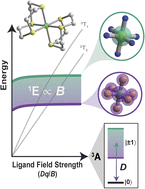
Creating the next generation of quantum systems requires control and tunability, which are key features of molecules. To design these systems, one must consider the ground-state and excited-state manifolds. One class of systems with promise for quantum sensing applications, which require water solubility, are d8 Ni2+ ions in octahedral symmetry. Yet, most Ni2+ complexes feature large zero-field splitting, precluding manipulation by commercial microwave sources due to the relatively large spin–orbit coupling constant of Ni2+ (630 cm−1). Since low lying excited states also influence axial zero-field splitting, D, a combination of strong field ligands and rigidly held octahedral symmetry can ameliorate these challenges. Towards these ends, we performed a theoretical and computational analysis of the electronic and magnetic structure of a molecular qubit, focusing on the impact of ligand field strength on D. Based on those results, we synthesized 1, [Ni(ttcn)2](BF4)2 (ttcn = 1,4,7-trithiacyclononane), which we computationally predict will have a small D (Dcalc = +1.15 cm−1). High-field high-frequency electron paramagnetic resonance (EPR) data yield spin Hamiltonian parameters: gx = 2.1018(15), gy = 2.1079(15), gz = 2.0964(14), D = +0.555(8) cm−1 and E = +0.072(5) cm−1, which confirm the expected weak zero-field splitting. Dilution of 1 in the diamagnetic Zn analogue, [Ni0.01Zn0.99(ttcn)2](BF4)2 (1′) led to a slight increase in D to ∼0.9 cm−1. The design criteria in minimizing D in 1 via combined computational and experimental methods demonstrates a path forward for EPR and optical addressability of a general class of S = 1 spins.

NEW PUBLICATION – Optimal coupling of HoW10 molecular magnets to superconducting circuits near spin clock transitions

A central goal in quantum technologies is to maximize GT2, where G stands for the coupling of a qubit to control and readout signals and T2 is the qubit’s coherence time. This is challenging, as increasing G (e.g., by coupling the qubit more strongly to external stimuli) often leads to deleterious effects on T2. Here, we study the coupling of pure and magnetically diluted crystals of HoW10 magnetic clusters to microwave superconducting coplanar waveguides. Absorption lines give a broadband picture of the magnetic energy level scheme and, in particular, confirm the existence of level anticrossings at equidistant magnetic fields determined by the combination of crystal field and hyperfine interactions. Such “spin clock transitions” are known to shield the electronic spins against magnetic field fluctuations. The analysis of the microwave transmission shows that the spin-photon coupling also becomes maximum at these transitions. The results show that engineering spin-clock states of molecular systems offers a promising strategy to combine sizable spin-photon interactions with a sufficient isolation from unwanted magnetic noise sources.

FSU Launches Quantum Initiative

FSU Quantum initiative has been established to advance university’s research and education in the areas of modern quantum science and technologies.

The mission of the FSU Initiative in Quantum Science and Engineering (FSU Quantum) is to accelerate the discovery of novel quantum phenomena that can impact the design of engineered systems for quantum information processing, communication, sensing, and algorithms, as well as devices and hardware that rely on quantum protocols.

The major goals of FSU Quantum are:

  • To operate at the interface between the basic sciences and engineering to ensure advancement of research on quantum science and quantum materials.
  • To create a vibrant, open academic program that fosters intra- and inter-institutional research collaborations, educates the future workforce in quantum science and engineering, and disseminates results to society.

Florida State University seeks multiple postdoctoral fellows to join the FSU Quantum Initiative.

NEW TEAM MEMBER – Dr. Ferdous Ara

Dr. Ferdous Ara is joining the Hill Group as postdoc. She completed Bachelor and Master degree in Physics at Shahjalal University of Science and Technology, Bangladesh. She earned PhD title at Tohoku University, Japan, specializing in molecular spintronics. After completing PhD, she continued research journey as a postdoctoral researcher at Tohoku University, working in the Advanced Scanning Probe Microscopy Laboratory. In this role, the primary focus was on utilizing low-temperature scanning tunneling microscopy (STM) techniques to characterize the electronic and spin states of individual molecules. Subsequently, she joined as a postdoctoral researcher at The Ohio State University, where the work was focused on the development of ESR-STM technology.

Now she joins the Hill Group at National High Magnetic Field Laboratory and The Florida State University, where she will be involved in an Electron Magnetic Resonance project, welcome.

NEW PUBLICATION – Strong magnetic exchange coupling in Ln2 metallocenes attained by the trans-coordination of a tetrazinyl radical ligand

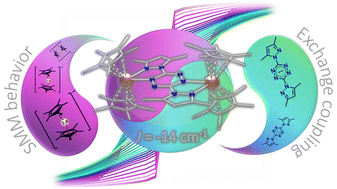
A combination of high-performing lanthanide metallocenes and tetrazine-based radical ligands leads to a new series of radical-bridged dinuclear lanthanide metallocenes; [(Cp*2LnIII)2(bpytz˙)][BPh4] (where Ln = Gd (1), Tb (2), Dy (3) and Y (4); Cp* = pentamethylcyclopentadienyl; bpytz = 3,6-bis(3,5-dimethyl-pyrazolyl)-1,2,4,5-tetrazine). The formation of the radical species is achieved via a controlled, stepwise synthesis and verified in all complexes by X-ray crystallography and SQUID magnetometry, as well as EPR spectroscopy of 4. Through the judicious choice of the Cp* ancillary ligands and by taking advantage of the steric effects imposed by their bulkiness, we were able to promote the trans coordination mode of the bpytz˙ radical anion that enables stronger magnetic exchange coupling compared to the cis fashion. This yields a JGd–rad = −14.0 cm−1 in 1, which is the strongest exchange coupling observed in organic monoanionic radical-bridged lanthanide metallocene systems. The strong Ln-rad exchange coupling was further confirmed by high-frequency EPR (HF-EPR) spectroscopy and broken-symmetry (BS) density functional theory (DFT) calculations. This combined with the highly anisotropic nature of TbIII and DyIII ions in 2 and 3, respectively, leads to strong SMM behavior and slow relaxation of the magnetization at zero fields.

NEW PUBLICATION – Terahertz EPR spectroscopy using a 36-tesla high-homogeneity series-connected hybrid magnet

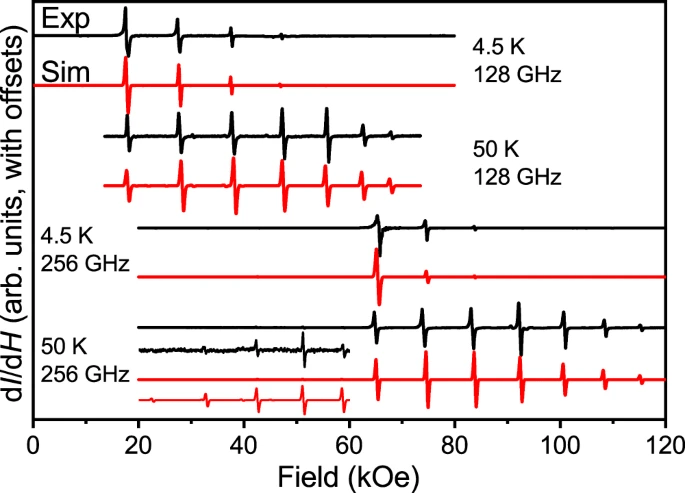
Electron Paramagnetic Resonance (EPR) is a powerful technique to study materials and biological samples on an atomic scale. High-field EPR in particular enables extracting very small g-anisotropies in organic radicals and half-filled 3d and 4f metal ions such as MnII (3d5) or GdIII (4f7), and resolving EPR signals from unpaired spins with very close g-values, both of which provide high-resolution details of the local atomic environment. Before the recent commissioning of the high-homogeneity Series Connected Hybrid magnet (SCH, superconducting + resistive) at the National High Magnetic Field Laboratory (NHMFL), the highest-field, high-resolution EPR spectrometer available was limited to 25 T using a purely resistive “Keck” magnet at the NHMFL. Herein, we report the first EPR experiments performed using the SCH magnet capable of reaching the field of 36 T, corresponding to an EPR frequency of 1 THz for g = 2. The magnet’s intrinsic homogeneity (25 ppm, that is 0.9 mT at 36 T over 1 cm diameter, 1 cm length cylinder) was previously established by NMR. We characterized the magnet’s temporal stability (5 ppm, which is 0.2 mT at 36 T over one-minute, the typical acquisition time) using 2,2-diphenyl-1-picrylhydrazyl (DPPH). This high resolution enables resolving the weak g-anisotropy of 1,3-bis(diphenylene)-2-phenylallyl (BDPA), Δg = 2.5 × 10–4 obtained from measurements at 932 GHz and 33 T. Subsequently, we recorded EPR spectra at multiple frequencies for two GdIII complexes with potential applications as spin labels. We demonstrated a significant reduction in line broadening in Gd[DTPA], attributed to second order zero field splitting, and a resolution enhancement of g-tensor anisotropy for Gd[sTPATCN]-SL.