NEW PUBLICATION – Substituent effects on exchange anisotropy in single- and multiorbital organic radical magnets

The contribution of heavy-atom substituents to the overall spin-orbit interaction in two classes of organic radical molecular magnets is discussed. In “single-orbital” radicals, spin-orbit coupling (SOC) effects are well described with reference to pairwise anisotropic exchange interactions between singly occupied spin-bearing orbitals on neighboring molecules; anisotropy requires the presence of spin density on heavy-atom sites with principal quantum number n>3. In “multiorbital” radicals, SOC involving virtual orbitals also contributes to anisotropic exchange and, as a result, the presence of heavy (n>3) atoms in formally non-spin-bearing sites can enhance pseudodipolar ferromagnetic interaction terms. To demonstrate these effects, ferromagnetic and antiferromagnetic resonance spectroscopies have been used to probe the exchange anisotropy in two organic magnets, one a “single-orbital” ferromagnet, the other a “multiorbital” spin-canted antiferromagnet, both of which contain a heavy-atom iodine (n=5) substituent. While the symmetry of the singly occupied molecular orbital in both radicals precludes spin-orbit contributions from iodine to the overall exchange anisotropy, the symmetry and energetically low-lying nature of the lowest unoccupied molecular orbital in the latter allows for appreciable spin density at the site of iodine substitution and, hence, a large exchange anisotropy.
NEW PUBLICATION – Engineering Clock Transitions in Molecular Lanthanide Complexes

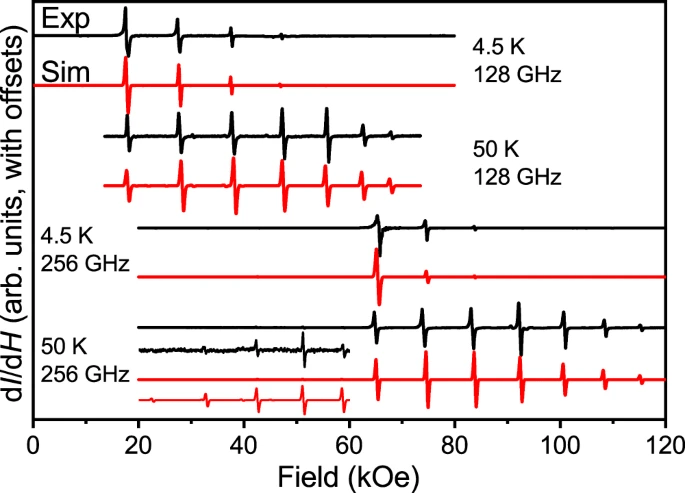
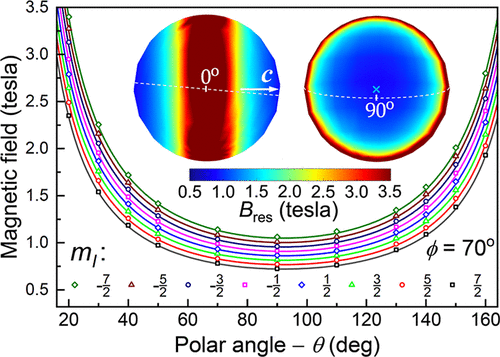
Molecular lanthanide (Ln) complexes are promising candidates for the development of next-generation quantum technologies. High-symmetry structures incorporating integer spin Ln ions can give rise to well-isolated crystal field quasi-doublet ground states, i.e., quantum two-level systems that may serve as the basis for magnetic qubits. Recent work has shown that symmetry lowering of the coordination environment around the Ln ion can produce an avoided crossing or clock transition within the ground doublet, leading to significantly enhanced coherence. Here, we employ single-crystal high-frequency electron paramagnetic resonance spectroscopy and high-level ab initio calculations to carry out a detailed investigation of the nine-coordinate complexes, [HoIIIL1L2], where L1 = 1,4,7,10-tetrakis(2-pyridylmethyl)-1,4,7,10-tetraaza-cyclododecane and L2 = F (1) or [MeCN]0 (2). The pseudo-4-fold symmetry imposed by the neutral organic ligand scaffold (L1) and the apical anionic fluoride ion generates a strong axial anisotropy with an mJ = ±8 ground-state quasi-doublet in 1, where mJ denotes the projection of the J = 8 spin–orbital moment onto the ∼C4 axis. Meanwhile, off-diagonal crystal field interactions give rise to a giant 116.4 ± 1.0 GHz clock transition within this doublet. We then demonstrate targeted crystal field engineering of the clock transition by replacing F with neutral MeCN (2), resulting in an increase in the clock transition frequency by a factor of 2.2. The experimental results are in broad agreement with quantum chemical calculations. This tunability is highly desirable because decoherence caused by second-order sensitivity to magnetic noise scales inversely with the clock transition frequency.

NEW PUBLICATION – Slow magnetic relaxation in a europium(II) complex

Single-ion anisotropy is vital for the observation of Single-Molecule Magnet (SMM) properties (i.e., a slow dynamics of the magnetization) in lanthanide-based systems. In the case of europium, the occurrence of this phenomenon has been inhibited by the spin and orbital quantum numbers that give way to J = 0 in the trivalent state and the half-filled population of the 4f orbitals in the divalent state. Herein, by optimizing the local crystal field of a quasi-linear bis(silylamido) EuII complex, the [EuII(N{SiMePh2}2)2] SMM is described, providing an example of a europium complex exhibiting slow relaxation of its magnetization. This behavior is dominated by a thermally activated (Orbach-like) mechanism, with an effective energy barrier of approximately 8 K, determined by bulk magnetometry and electron paramagnetic resonance. Ab initio calculations confirm second-order spin-orbit coupling effects lead to non-negligible axial magnetic anisotropy, splitting the ground state multiplet into four Kramers doublets, thereby allowing for the observation of an Orbach-like relaxation at low temperatures.

NEW PUBLICATION – On-surface magnetocaloric effect for a van der Waals Gd(III) 2D MOF grown on Si

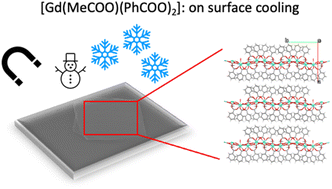
Gd complexes have been studied as magnetic coolants due to their large magneto-caloric effect. In this work we present a Gd 2D metal–organic framework (MOF) of formula [Gd(MeCOO)(PhCOO)2] (1). We characterize the magnetic properties of 1, showing that it displays slow relaxation of the magnetization by ac susceptibility, and single-ion magnetic anisotropy using high-field EPR. By heat capacity and magnetization vs. field at various temperatures we determine the magnetic entropy change of compound 1. We then grow 1 on functionalized silicon, and show that the surface-deposited 2D MOF 1Si can be used as an on-surface magnetic cryogenic coolant.

Also featured as a cover page for Journal of Materials Chemistry A, 21 March 2024, Issue 11, Page 6149 to 6778.

APS TV Video Highlight – Quantum Initiative at Florida State University

American Physical Society (APS) TV features our lab in video highlight about FSU Quantum Initiative at Florida State University.

APS TV Video Highlight, March 2024.

The FSU Quantum Initiative at Florida State University is at the forefront of quantum science and engineering, with a focus on groundbreaking research and innovation. The initiative has made bold investments, dedicating over $20 million to quantum science and engineering over the next three years. This funding supports the hiring of new faculty members, acquisition of equipment, and the establishment of dedicated space in the Interdisciplinary Research and Commercialization Building. Additionally, seed money has been allocated for a new program focused on this emerging field.

FSU Quantum is actively involved in exploring quantum information science and developing new technologies as part of the National Quantum Initiative, a $2.6 billion federal effort. Researchers at FSU are engaged in various projects, such as developing quantum bit platforms and participating in research initiatives sponsored by agencies like the Department of Energy. Quantum engineering at FSU leverages the principles of quantum mechanics to push technological boundaries. Quantum computers, for instance, harness the unique properties of quantum bits to solve complex problems efficiently. FSU’s investments aim to position the university as a major player in quantum science and engineering, bridging the gap in the Southeast and solidifying its leadership in this transformative field.

NEW PUBLICATION – Identification of an X-Band Clock Transition in Cp′3Pr– Enabled by a 4f2 5d1 Configuration

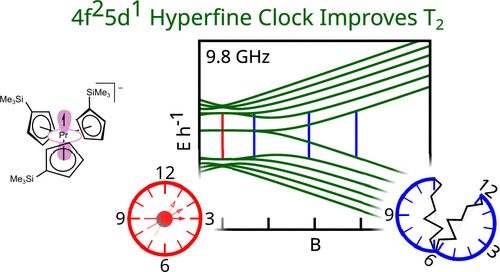
Molecular qubits offer an attractive basis for quantum information processing, but challenges remain with regard to sustained coherence. Qubits based on clock transitions offer a method to improve the coherence times. We propose a general strategy for identifying molecules with high-frequency clock transitions in systems where a d electron is coupled to a crystal-field singlet state of an f configuration, resulting in an MJ = ±1/2 ground state with strong hyperfine coupling. Using this approach, a 9.834 GHz clock transition was identified in a molecular Pr complex, [K(crypt)][Cp′3PrII], leading to 3-fold enhancements in T2 relative to other transitions in the spectrum. This result indicates the promise of the design principles outlined here for the further development of f-element systems for quantum information applications.

NEW TEAM MEMBER – Dr. Kavipriya Thangavel

Dr. Kavipriya Thangavel, our new postdoctoral associate in the Hill Group, holds Bachelor’s and Master’s degrees in Physics from Bharathiar University, India. She began her research journey as a Junior Research Fellow at the Department of Physics, Indian Institute of Technology Madras (IITM, India), investigating the structural and magnetic transitions in electron-doped Manganite Oxide and exploring its magnetocaloric Properties. Kavi furthered her academic pursuits through a joint doctoral program facilitated by the European Union’s Horizon 2020 research and innovation program under the Marie Skłodowska-Curie Actions Fellowship – PARACAT (https://paracat.eu/wp/). This endeavor led her to obtain double doctoral degrees from Leipzig University (Physics) and Cardiff University (Chemistry). In this PhD program, her work focus on the ‘Elucidation of the Role of Paramagnetic Valence States of High Spin Transition Metal Ions in Metal-Organic Frameworks by EPR Spectroscopy’.

She is now part of the Hill Group at the National High Magnetic Field Laboratory, set to delve into research using the W-band HiPER spectrometer. Welcome aboard!

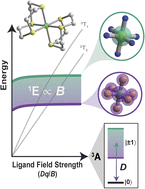
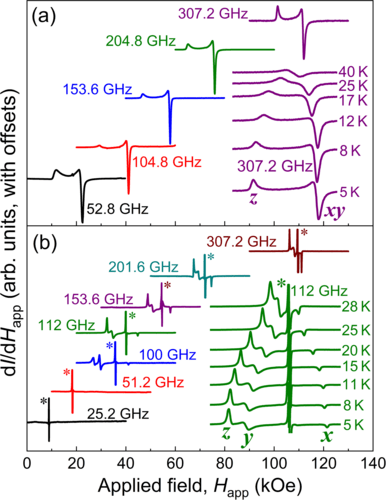
NEW PUBLICATION – Ligand field design enables quantum manipulation of spins in Ni2+ complexes

Creating the next generation of quantum systems requires control and tunability, which are key features of molecules. To design these systems, one must consider the ground-state and excited-state manifolds. One class of systems with promise for quantum sensing applications, which require water solubility, are d8 Ni2+ ions in octahedral symmetry. Yet, most Ni2+ complexes feature large zero-field splitting, precluding manipulation by commercial microwave sources due to the relatively large spin–orbit coupling constant of Ni2+ (630 cm−1). Since low lying excited states also influence axial zero-field splitting, D, a combination of strong field ligands and rigidly held octahedral symmetry can ameliorate these challenges. Towards these ends, we performed a theoretical and computational analysis of the electronic and magnetic structure of a molecular qubit, focusing on the impact of ligand field strength on D. Based on those results, we synthesized 1, [Ni(ttcn)2](BF4)2 (ttcn = 1,4,7-trithiacyclononane), which we computationally predict will have a small D (Dcalc = +1.15 cm−1). High-field high-frequency electron paramagnetic resonance (EPR) data yield spin Hamiltonian parameters: gx = 2.1018(15), gy = 2.1079(15), gz = 2.0964(14), D = +0.555(8) cm−1 and E = +0.072(5) cm−1, which confirm the expected weak zero-field splitting. Dilution of 1 in the diamagnetic Zn analogue, [Ni0.01Zn0.99(ttcn)2](BF4)2 (1′) led to a slight increase in D to ∼0.9 cm−1. The design criteria in minimizing D in 1 via combined computational and experimental methods demonstrates a path forward for EPR and optical addressability of a general class of S = 1 spins.